-
 Austin American, “Shivers Says Order Sound”
 This article acts as a link to the national and state level politics. Eisenhower reveals in a press conference that he did know the circumstances on Mansfield and Shivers continues to stand by his actions during the crisis. This can be used to show how papers in Austin reported the political actions taken during the crisis.
-
 Austin American, “Put Clamps On Mob: Allan’s Act Draws Fire By NAACP”
 This article shows how the Austin American paper continued to report the aftermath of Mansfield because it still remained relevant. This also describes the NAACP view on Shivers actions and the court orders.
-
 Austin American, “Mob Threaten In Three States”
 This newspaper compares the events in Mansfield to two other fights for integration in across the country, the two being located in Clinton, Tennessee, and Sturgis, Kentucky. The article reports the actions of NAACP attorney L. Clifford Davis, stating that no Negro students will be registered at Mansfield because of the threat of mob violence. The article also mentions the account of Reverend Clark who was escorted from the grounds after attempting to make peace with the mob. This article reports the most violent and controversial accounts of the crisis at Mansfield in order to compare its situation with those in Clinton and Sturgis which are arguably more violent.
-
 Austin American, “Race Unrest Quieter in Texas Cities”
 Following Augusts 30th and 31st Austin Newspapers still continued to print articles about the state of Mansfield. It had been two days since the mob had formed outside Mansfield high school but the newspaper believes that there will be more demonstrations on September 4th the first day of class. In conjunction with this, the Newspaper discuses that story of Lloyd G. Austin resident of Riverside Forth Worth just 20 miles away from Mansfield. Violence erupts outside Austin’s home when a mob forms and begins to throw bottles at the house. Austin fires a shot from his home and police arrive shortly armed with tear gas and other weapons. The crowd quickly dispersed once police officers arrive. Since both of these stories are covered in the same article we can infer that this newspaper continues to report the most violent accounts of the crisis.
-
 Austin American, “Justice Minton Permits Mansfield Delay Petition”
 The Austin American Newspaper also includes a detailed account of the court proceeds evolving Mansfield. On September 2nd the newspaper published an article that includes the fight for Mansfield to legally remain segregated. Attorney for the Mansfield school district, J. A. Gooch receives permission from the U.S. Supreme Court justice Sherman Minton to request a delay of integration. Gooch sent a copy of the story of the controversy at Mansfield along with a petition to Judge Hugo Black in order to receive a delay of court order. This petition was one of the last means left in order for the school board to lawfully no allow Negro on campus.
-
 Austin American, “Mob Turns Home but Hate Remains”
 The mob that gathered outside Mansfield high school did not want Negros to register but they also did not want “outsiders” to intervene with their protest. Many mob members felt that the “outsiders” such as the NAACP were the cause of all of this trouble. Irwin Frank, a witness, reports the violence that occurred when assistant district attorney Grady Hight appeared on scene. Hight was reported to have made a comment regarding the mob and a scuffle broke out. Hight was escorted away by a Texas Ranger before any harm was done. Frank also mentions how two news reporters were driven away for being “outsiders” even though both of the men were from the area. Frank includes his personal account of himself being driven off the road by two citizens of Mansfield who wanted to make sure that he wasn’t “some damn instigator from out of town”. Newspaper articles found in Austin give detailed account of the violence that occurred in order to maintain relevance. The article also ran in The Dallas Morning News.
-
 The Dallas Morning News, “Ike Backs Action in Mansfield Row”
 This article supports our narrative that Dallas is publishing news about Mansfield from a national level and can aid to the bridge between national and state level coverage.
-
 The Dallas Morning News, “Dallas Legal Test Ground For NAACP Court Actions”
 This article supports our narrative Dallas was focused on the situation in Mansfield in a larger context. The author mainly focuses on Dallas but also mentions Fort Worth and Houston.
-
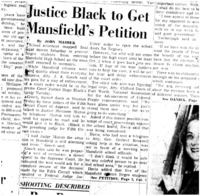 The Dallas Morning News, “Justice Black to Get Mansfield’s Petition”
 Justice Black was expected to rule on a court order enjoining black students from attending Mansfield High School after the crisis took place. This article supports our narrative that the Dallas Morning News also focused on the legality of the crisis at Mansfield.
-
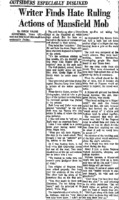 Dallas Morning News, "Writer Finds Hate Ruling Actions of Mansfield Mob"
 Newspaper article by reporter Irwin Frank detailed a version of the events that transpired at Mansfield on August 31, 1956. The AP article ran September 1, 1956 in the Dallas Morning News and indicated the segregationists were hostile to the Assistant District Attorney as well as reporters on scene to cover the event. Frank also reported on non-protesters and indicated a friendlier side to existing relationships within the community.
-
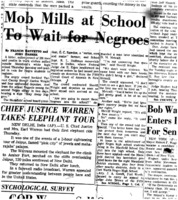 The Dallas Morning News, “Mob Mills at School To Wait for Negroes”
 This article gives the account of how the morning of the August 30th, the first day that the mob assembled, played out. This supports our narrative that the coverage in Dallas is more detailed and focused on violence.
-
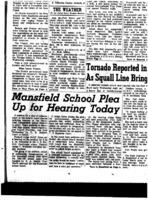 Fort Worth Star-Telegram, “Mansfield School Plea Up For Hearing Today”
 This article supports our narrative that Forth Worth was reporting on the case of Mansfield before that crisis had occurred. Reportage focused on the court hearings as well as the protest going on within Mansfield.
-
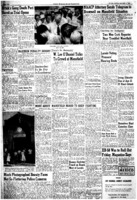 Fort Worth Star-Telegram September 1, 1956 coverage of Mansfield desegregation crisis
 The Fort Worth Star-Telegram's coverage of the Mansfield mob on September 1, 1956 included several other stories related to the desegregation crisis.
The National Association for the Advancement of Colored People (NAACP) sent telegrams to the U.S. Attorney General asking for protection for the African American children wanting to enroll at Mansfield High School. Gubernatorial candidate W. Lee O'Daniel used the mob scene in Mansfield as a campaign stop, and an Associated Press reporter covering the events was stopped by two men in a vehicle wanting to "make sure you weren't some instigator from out of state."
-
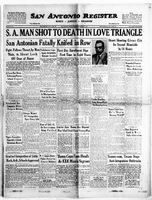 San Antonio Register, "Tennesseans, Texans Stage Anti-Integration Outbreak”
 This can be used to support our argument that black newspapers were more focused with putting Mansfield into a larger context by including it in an article about the actions in Clinton.
-
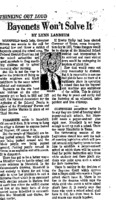 Dallas Morning News, "Bayonets Won't Solve It"
 An opinion piece by Lynn Landrum indicated a need for a “friendlier way” in dealing with the school integration issue. The article noted the crowd response to integration was in reaction to being “pushed around” by the Supreme Court.
Segregated schools existed in Mansfield. African American high school students attended I.M. Terrell in Fort Worth. Various improvement requests for the Mansfield Colored School were denied by the school board. As a result the NAACP filed a class action suit the year prior for admittance of all African American students in Mansfield. A federal court ordered desegregation on August 27, 1956, which led to protestors gathering on school grounds on Thursday, August 30 and Friday, August 31.
-
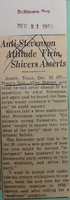 Baltimore Sun 1955-12-21
 Allan Shivers says he'll never change in his opposition to Adlai Stevenson, but hoped that the Democrats would nominate a "moderate" candidate. Shivers claims that in the last twenty years a new group of leaders has appeared in the Democratic Party, seeking to "mis-use, misdirect, and abuse the party".
This demonstrates the political tensions and divisions taking place in the Democratic Party. Shivers makes it clear that he is not supportive of the current Democratic nominee for the 1956 presidential election.
-
 Providence Journal 1956-02-26
 Allan Shivers is going to announce whether he'll seek a fourth term as the governor of Texas. Shivers decision could have a potential effect on the 1956 national political picture.
This demonstrates the impact of Shivers political influence across the country.
-
 New York Times 1956-06-29
 Allan Shivers states that expulsion of the Southern Democrats from the Democratic Party might force Southern Senators and House members to form a coalition with the Republicans. Shivers acknowledges that there is a clear division between liberals and conservatives in the Democratic Party. The Governor says that he will "probably" support Dwight D. Eisenhower again in the 1956 presidential campaign. Shivers says that he will not support the Democratic nominees Adlai Stevenson and Lyndon B. Johnson.
This demonstrates the political divisions in the Democratic Party, and that Shivers will continue to support Eisenhower in the 1956 presidential election.
-
 Washington Star 1956-06-29
 Allan Shivers say that he'll "probably" support Dwight D. Eisenhower in the 1956 presidential election, and that he will not support Adlai Stevenson and Lyndon B. Johnson for the Democratic ticket. The Governor criticizes the Supreme Court for overstepping it's boundaries by calling it a "super legislature", and reiterates the 10th Amendment on state's rights.
This demonstrates that Shivers will continue to support Eisenhower in the next presidential election. Shivers also states his stance on the Supreme Court and state's rights.
-
 New York Herald Tribune 1956-06-30
 Allan Shivers states that he will support Dwight D. Eisenhower again in the 1956 presidential election. Shivers says that he will not "back Adlai Stevenson". The Governor declines to discuss any other Democratic "hopefuls" for the 1956 presidential election.
This demonstrates Shivers adamant support for Eisenhower, and the tensions taking place in the Democratic Party.
-
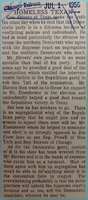 Chicago Tribune 1956-07-01
 Allan Shivers acknowledges that the Democratic Party is in a dilemma due conflicting policies, particularly the Supreme Court on segregation. Shivers campaigned for Dwight D. Eisenhower in the 1952 presidential election.
This demonstrates the political tensions in the Democratic Party, and the Democrats differing opinions on the Supreme Court and desegregation.
-
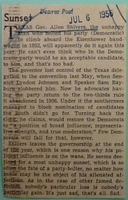 Denver Post 1956-07-06
 Allan Shivers "bolted his party" (Democratic) for Dwight D. Eisenhower in the 1952 presidential election. The Governor states that can not think of a Democrat nominee that would be acceptable for the 1956 presidential election. During the last delegation in Texas, Shivers lost control of the Democratic party in Texas against his rivals; Lyndon B. Johnson and Samuel Rayburn.
This demonstrates the tensions of the Democratic Party in Texas after the 1952 presidential election.
-
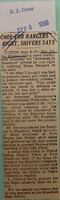 New York Times 1956-09-08
 Allan Shivers say calling the Texas Rangers to Mansfield High School, in Mansfield, Texas was the "right thing to do". Although the African American teenagers were denied admission into Mansfield High School, Shivers states that "peace was restored to the community". At President Eisenhower's news conference, he was asked if Shivers actions would be considered in defiance against the Supreme Court.
This demonstrates Shivers actions taken at Mansfield, and Eisenhower's stance on the Supreme Court decision, pertaining to segregation,
-
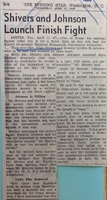 Washington Star 1956-04-11
 Allan Shivers and Senator Lyndon B. Johnson debate in the National Democratic Convention Delegation. Texas Democrats have been divided since Shivers led the G.O.P. campaign for Dwight D. Eisenhower in 1952. Johnson attempts to unite the Democratic Party of Texas, but says that he won't let himself be used as a rallying point for Southern conservatives fighting the Supreme Court desegregation opinion.
This demonstrates the split among the Democrats in Texas after the 1952 presidential election, and the Supreme Court desegregation decision.
-
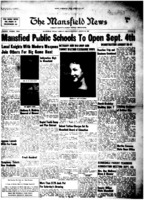 The Mansfield News coverage from August 30, 1956 of the beginning of Mansfield High School desegregation resistance
 The front page of The Mansfield News, dated August 30, 1956, recorded the indignation expressed by the predominantly white community to the mandatory court order on school integration. The article referenced an effigy "swaying realistically" from the school flagpole along with a “very artfully decorated” car at the scene.