-
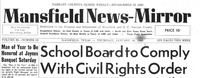 Mansfield News-Mirror front page coverage of school board decision to integrate
 On January 28, 1965, the Mansfield News-Mirror published a front-page story about the school board’s decision to integrate Mansfield schools. It also published a page 1 editorial encouraging the community to support the board’s decision and called for “sound thinking and responsible action” as well as a healing of “the wounds of the past.”
-
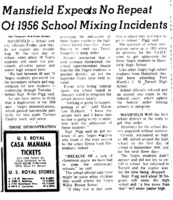 Fort Worth Star-Telegram article previewing Mansfield integration event in August 1965
 On August 21, 1965, the Fort Worth Star-Telegram published an article titled "Mansfield Expects No Repeat of 1956 School Mixing Incidents." This article describes the mentality of the population of Mansfield by stating that they don’t expect to face any resistance. Sixty to seventy African American students pre-enrolled into Mansfield’s junior and senior high schools to start attending in the fall of 1965.
-
 New York Times 1955-10-20
 Allan Shivers calls Adlai Stevenson, the Democratic nominee for the 1956 presidential election "coy". The Governor describes Stevenson as "the most extreme, in the most extreme group". This demonstrates that Shivers is not satisfied with the Democratic presidential nominee, and will continue to support Dwight D. Eisenhower in the next presidential campaign. This also demonstrates the division of the Democratic Party.
-
 The Corpus Christi Times 1956-09-01
 This article gives a detailed account of the actions surrounding the Mansfield Crisis. Without going into much detail about the Grady Hight and photographer incidents, the article discusses, in depth, Governor Shivers’ call to the Texas Rangers and the reason behind it. It also details his curt response to L. Clifford Davis’ appeal for help for the students.
-
 The Corpus Christi Times 1956-08-31
 This day had the most articles written about Mansfield. The first article is a story about the NAACP pushing the black students to enter into the court case. Focusing on Floyd Moody, the article alleges that he never wanted to go to Mansfield, that he preferred his “own people”, but that he would go to Mansfield if the NAACP made him. This article, which ran in several newspapers, created the backlash that saw Attorney General Ben Shepperd file suit against the NAACP.
The second article focuses solely on the Mansfield School Boards’ appeal in Houston, informing the reader that the board’s last appeal is to the U.S. Supreme Court.
The smallest article is the same updated headline that was in the El Paso Herald Post on the same day, August 31. Below this update, the same Irwin Frank article from the Fort Worth Star Telegram was printed.
-
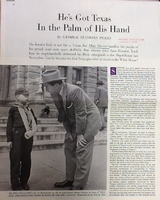 Saturday Evening Post 1953-06-27
 A reporter gives a description of Allan Shivers.
-
 Christian Science Monitor 1954-08-13
 Allan Shivers has "bolted" his party to work for the 1952 presidential election for Dwight D. Eisenhower. Shivers broke the "Solid South", which had consistently voted for Democratic presidential candidates since the end of Reconstruction. The Governor says public school segregation of races will not be discontinued as long as he his Governor. Samuel Yarborough, Shivers opponent in the 1954 Governor's race claims that Yarborough has had "secret communications with the National Association for Colored People (NAACP) during the campaign. This demonstrates the break down of the Democratic Party in Texas and the South, and Shivers stance on school segregation.
-
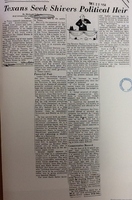 Christian Science Monitor 1954-12-21
 Due to Texas' population expansion and population growth, the state has become an important political post for presidential campaigns. During the 1952 presidential campaign, Governor Allan Shivers supported the Republican candidate, Dwight D. Eisenhower. This started a division between the conservative and liberal Democrats of Texas. This demonstrates the political divisions in the Democratic Party, in Texas.
-
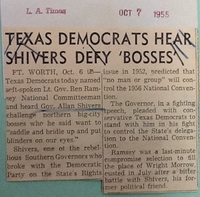 Los Angeles Times 1955-10-07
 Allan Shivers challenges northern "big city bosses" who he said want to "saddle up and put blinders on our eyes". Shivers pleas for conservatives to join him on the the fight for states' rights. This demonstrates Shivers strong stance on states' rights.
-
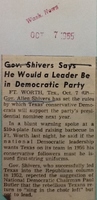 Washington News 1955-10-07
 Allan Shivers announces that if the national Democratic leadership wants Texas in the 1956 presidential campaign then the party nominee must be exceptional. This demonstrates that Shivers is not supportive of the current Democratic nominees for the next presidential election, but the issue leaves the Democratic Party divided.
-
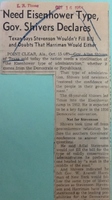 Los Angeles Times 1955-10-14
 Allan Shivers announces that the Eisenhower administration should continue whether it comes from a Democrat or a Republican. The Governor says he will plan on supporting Dwight D. Eisenhower in the 1956 presidential election. Shivers remains opposed to Adlai Stevenson, since Stevenson does not "fit the bill for a mildly conservative". This demonstrates that Shivers is dissatisfied with the Democratic candidates, and remains adamantly supportive of Eisenhower.
-
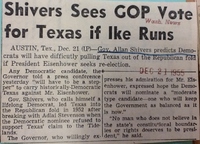 Washington News 1955-12-21
 Allan Shivers believes Democrats will have a hard time taking Texas in the 1956 presidential election. Shivers states that he will not support the Democratic nominee, Adlai Stevenson, since he refused to support Texas' claim to the tidelands. Shivers expresses his support for Dwight D. Eisenhower since Eisenhower is a "moderate type" of candidate, and who will keep the government balanced. This demonstrates Shivers adamant support for Eisenhower.
-
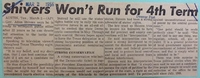 Denver Post 1956-03-02
 Allan Shivers announces his retirement from public office. Shivers supported Dwight D. Eisenhower during the 1952 presidential election, since Eisenhower signed over the tidelands to Texas. The Governor states his stance on states' rights, but denies his stance had anything to do with schools or segregation. Instead, Shivers claims that states rights specifically protected "federal interference". This demonstrates that states' rights position was a way to oppose integration in public schools.
-
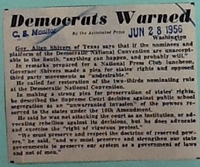 Christian Science Monitor 1956-06-28
 Allan Shivers makes his stance on states rights, by opposing the Supreme Court decision against public school segregation. This demonstrates Shivers views on the Brown decision, school segregation, and states rights.
-
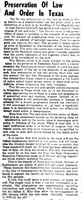 The Houston Informer 1956-09-15
 This editorial was the only mention of Mansfield for this day. Written nearly two weeks after the Crisis, it decried Governor Shivers’ actions in Mansfield. By sending in the Texas Rangers and ordering school officials to transfer out any students whose presence would be disruptive, this article claims he not only subverted the court order to desegregate immediately, he gave way to mob rule. They contrasted his decisions with those taken by the governor in Tennessee in regards to the events at Clinton.
-
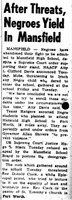 The Houston Informer 1956-09-08 pt. 3
 This article, found toward the back of the paper, finally discussed the events at Mansfield. It gave a cursory overview of the actions by the mob, the courts, and Governor Shivers. It also incorrectly stated that the Texas Rangers escorted Negro students to Fort Worth to attend school.
-
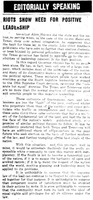 The Houston Informer 1956-09-08 pt. 2
 This editorial was placed two pages ahead of the article about the Mansfield Crisis. It was a commentary on what Mansfield meant to the law of the land. According to the article, the actions taken by the white mob, Governor Shivers, and the Texas Rangers, were in direct conflict with the lawful order to desegregate. It continued in a commentary about what this meant for the state and society in general.
-
 The Houston Informer 1956-09-08
 This article was on the front page of the paper after the Mansfield Crisis. It was focused on the events in Fort Worth with Lloyd G. Austin and the protestors at his home.
-
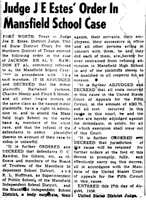 The Houston Informer 1956-09-01
 This article was simply a copy of the order from Judge Estes’ ruling on Jackson v. Rawdon. This was the lone article from the Houston Informer during the Mansfield Crisis.
-
 The Corpus Christi Times 1956-09-05
 This article gives the perspective of President Eisenhower to the issue of integration. The reporters, using Mansfield and Governor Shivers’ response to it, tried to get a straight answer out of the President, but only received the tale that he was not familiar enough with the actions to comment. It does note, however, that he believes each states’ response to their individual integration issues was effective in preventing violence. He refused to endorse the Supreme Court’s decision in Brown v. Board of Education, however.
-
 The Corpus Christi Times 1956-09-04
 This article details events at the school, including the arrival and departure of Rev. Clark, along with the harsh words from the mob. This came at the same time that the Rangers were told to transfer out of the district any students whose presence would be disruptive to the school, white or black. The rest of the article relates the story of Lloyd G. Austin in Fort Worth and the racial tensions in Alvarado in comparison to the problems at Mansfield.
-
 The Corpus Christi Times 1956-08-30
 This article provides a detailed account of events at Mansfield, including quotes from the mob. It very much focuses on the threats made by these men, as well as the non-committal responses from the school’s principal and the superintendent. The phone threat to T.M. Moody is discussed in better detail than in the Amarillo article. This article also focuses on the court process that the school board is currently going through. It includes the exact ruling made by Judge Joe Estes in the appeal to delay segregation.
-
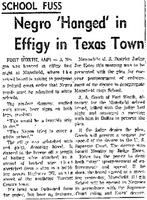 The Corpus Christi Times 1956-08-29
 This article focuses on the effigy found hanging on Main Street in Mansfield. Pulled off of the Associated Press wire, gives great detail to what the effigy looked like, and spells out the court appeals that the Mansfield School Board is currently pursuing.
-
 Washington Star 1956-03-28
 Rivalries are developing among the Democratic leaders in Texas. Allan Shivers "bolted" the Democrats to support Dwight D. Eisenhower in the 1952 presidential election. Samuel Rayburn names Senator Lyndon B. Johnson as "Texas' Favorite Son", due to his loyalty to the Democratic Party. This demonstrates the political tensions in Texas among the Democratic Party, after Shivers support for Eisenhower in the 1952 presidential election.
-
 Baltimore Sun 1955-09-26
 Allan Shivers sent Dwight D. Eisenhower a telegram, "we are remembering you in our prayers". This demonstrates the close relationship Shivers and Eisenhower had during their time in political office, and how Shivers helped carry Texas for Eisenhower in the last presidential election, in 1952.