-
 Southern School News-July 1957
 The NAACP posted a $5,000 bond with the district clerk as Judge Otis T . Dunagan filed his "findings of fact and conclusion of law." The two steps were needed before the NAACP appealed to the State Court of Civil Appeals at Texarkana. Further appeal could be made to the state supreme court and then to U. S. Supreme Court. The NAACP requested a 30-day extension to file exceptions to Judge Dunagan's findings. The NAACP is now free to carry out its purpose as it did before last Sept. 19, 1956.
-
 Southern School News-June 1957
 State District Judge Otis T. Dunagan of Tyler issued an order permanently enjoining the National Association for the Advancement of Colored People from certain acts, but he did not require the group to stop operating in Texas as requested in a lawsuit filed by former Attorney General John Ben Shepperd. NAACP attorney W.J. Durham said after Judge Dunagan's decision: "Officers and committee members of the Texas conference [NAACPJ are not seriously aggrieved by the judgment of the Tyler court. They feel they are not enjoined from any act they could have done lawfully under our charter before the Tyler suit."
-
 Southern School News-May 1957
 At Tyler, trial began April 29 in the state's effort to get a permanent injunction against the NAACP. A temporary injunction was granted last September by District Judge Otis T. Dunagan. The case originally was set for April 22. Delay was sought by both sides. The court was told that the State Bar of Texas might intervene in the case of alleged barratry by NAACP attorneys in filing integration lawsuits.
-
 Southern School News-April 1957
 Dist. Judge Otis T. Dunagan rejected NAACP's motion to move the trial from Tyler to Dallas or Austin and set a trial for April 15 on the state's request for permanent injunction against the NAACP. At the request of former Attorney General John Ben Shepperd, the organization has been under a temporary injunction since Sept. 21, 1956. The state said the NAACP violated Texas law by making money on a non-profit charter as well as soliciting litigation on integration suits.
-
 Southern School News-March 1957
 State District Judge Otis T. Dunagan at Tyler said his decision on the National Association for the Advancement of Colored People's motion to move the trial of the state's ouster suit from Tyler to Dallas or Austin would come in March. The organization is currently under a temporary Injunction against operation in the state.
-
 Southern School News-February 1957
 Written arguments were filed in the dispute over whether the trial of the state's suit for permanent injunction against the National Association for the Advancement of Colored People would be held at Tyler or moved to another Texas city. State District Judge Otis T. Dunagan was expected to decide this question early in February. The removal was sought by the NAACP. Judge Dunagan earlier entered a temporary injunction against further operation of the organization in Texas.
-
 Southern School News-January 1957
 At Tyler, State District Judge Dunagan delayed until January or later his decision on the NAACP's request to have the state's ouster suit (State of Texas v. NAACP) tried at Dallas or Austin. "The NAACP does not volunteer legal aid to anyone unless aid is requested," said Thurgood Marshall. "Such aid is not extended to persons violating the order of the nation's Supreme Court."
-
 Southern School News-December 1956
 State District Judge Otis T. Dunagan of Tyler started hearings Dec. 3 on the National Association for the Advancement of Colored People to hold the next trial of the state's ouster suit (State of Texas v. NAACP). The NAACP dropped its appeal to the Texas Court of Civil Appeals at Texarkana to concentrate a harder fight against making Judge Dunagan's order permanent. NAACP attorneys contend that Dallas or Austin would be a more neutral spot for the trial. If Judge Dunagan will not move the trial, the NAACP urged a prompt trial on the permanent injunction.
-
 Southern School News-November 1956
 Judge Dunagan issued a temporary injunction against further operation of the NAACP in Texas after a 17-day hearing, which included over a million words of testimony and more than 500 exhibits. The injunction remained in effect pending appeal.
-
 Southern School News-October 1956
 In Tyler, the initial highlight of the court fight was the disclosure of the NAACP contract to pay $11,500 to Heman Sweatt. District Judge Otis T. Dunagan granted a temporary restraining order/injunction against the NAACP after Attorney General Shepperd brought suit against the NAACP. Shepperd claimed that the NAACP was a corporation based in New York and did not have a permit to operate in Texas. He also argued that the NAACP was violating barratry laws. Thurgood Marshall, NAACP chief council, called this "the greatest crisis" in the organization's history.
-
 Southern School News-February 1956
 Governor Shivers expressed great interest in "interposition" breaking an official silence on that subject. NAACP officials in a statewide meeting held in Austin decided to attack. "vigorously" in court the segregation of Negroes in schools parks, public health facilities, public housing, swimming pools and buses. The group promised a "no compromise, head-on fight."
-
 Southern School News-November 1955
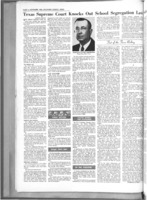
 Texas Supreme Court in R.E McKinney et al v. W.C. Blankenship et al declared Texas Statutes that legalized the segregated school system were unconstitutional. In response, Governor Shivers and Attorney General Shepperd made public statements that this decision does not call for any speed-up of desegregation, stating, "In the light of these decisions, no school district should feel compelled to take hasty or unnecessary action." They also said there would be no plan to appeal the court's decision.