-
 Southern School News-February 1957
 Written arguments were filed in the dispute over whether the trial of the state's suit for permanent injunction against the National Association for the Advancement of Colored People would be held at Tyler or moved to another Texas city. State District Judge Otis T. Dunagan was expected to decide this question early in February. The removal was sought by the NAACP. Judge Dunagan earlier entered a temporary injunction against further operation of the organization in Texas.
-
 New York Herald Tribune 1956-06-30
 Allan Shivers states that he will support Dwight D. Eisenhower again in the 1956 presidential election. Shivers says that he will not "back Adlai Stevenson". The Governor declines to discuss any other Democratic "hopefuls" for the 1956 presidential election.
This demonstrates Shivers adamant support for Eisenhower, and the tensions taking place in the Democratic Party.
-
 Southern School News-January 1957
 At Tyler, State District Judge Dunagan delayed until January or later his decision on the NAACP's request to have the state's ouster suit (State of Texas v. NAACP) tried at Dallas or Austin. "The NAACP does not volunteer legal aid to anyone unless aid is requested," said Thurgood Marshall. "Such aid is not extended to persons violating the order of the nation's Supreme Court."
-
 Southern School News-December 1956
 State District Judge Otis T. Dunagan of Tyler started hearings Dec. 3 on the National Association for the Advancement of Colored People to hold the next trial of the state's ouster suit (State of Texas v. NAACP). The NAACP dropped its appeal to the Texas Court of Civil Appeals at Texarkana to concentrate a harder fight against making Judge Dunagan's order permanent. NAACP attorneys contend that Dallas or Austin would be a more neutral spot for the trial. If Judge Dunagan will not move the trial, the NAACP urged a prompt trial on the permanent injunction.
-
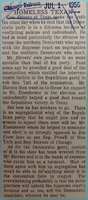 Chicago Tribune 1956-07-01
 Allan Shivers acknowledges that the Democratic Party is in a dilemma due conflicting policies, particularly the Supreme Court on segregation. Shivers campaigned for Dwight D. Eisenhower in the 1952 presidential election.
This demonstrates the political tensions in the Democratic Party, and the Democrats differing opinions on the Supreme Court and desegregation.
-
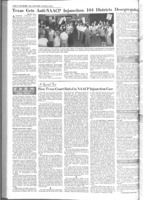 Southern School News-November 1956
 Judge Dunagan issued a temporary injunction against further operation of the NAACP in Texas after a 17-day hearing, which included over a million words of testimony and more than 500 exhibits. The injunction remained in effect pending appeal.
-
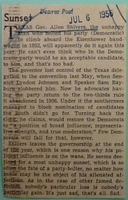 Denver Post 1956-07-06
 Allan Shivers "bolted his party" (Democratic) for Dwight D. Eisenhower in the 1952 presidential election. The Governor states that can not think of a Democrat nominee that would be acceptable for the 1956 presidential election. During the last delegation in Texas, Shivers lost control of the Democratic party in Texas against his rivals; Lyndon B. Johnson and Samuel Rayburn.
This demonstrates the tensions of the Democratic Party in Texas after the 1952 presidential election.
-
 Southern School News-October 1956
 In Tyler, the initial highlight of the court fight was the disclosure of the NAACP contract to pay $11,500 to Heman Sweatt. District Judge Otis T. Dunagan granted a temporary restraining order/injunction against the NAACP after Attorney General Shepperd brought suit against the NAACP. Shepperd claimed that the NAACP was a corporation based in New York and did not have a permit to operate in Texas. He also argued that the NAACP was violating barratry laws. Thurgood Marshall, NAACP chief council, called this "the greatest crisis" in the organization's history.
-
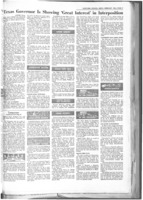 Southern School News-February 1956
 Governor Shivers expressed great interest in "interposition" breaking an official silence on that subject. NAACP officials in a statewide meeting held in Austin decided to attack. "vigorously" in court the segregation of Negroes in schools parks, public health facilities, public housing, swimming pools and buses. The group promised a "no compromise, head-on fight."
-
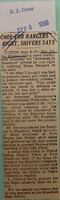 New York Times 1956-09-08
 Allan Shivers say calling the Texas Rangers to Mansfield High School, in Mansfield, Texas was the "right thing to do". Although the African American teenagers were denied admission into Mansfield High School, Shivers states that "peace was restored to the community". At President Eisenhower's news conference, he was asked if Shivers actions would be considered in defiance against the Supreme Court.
This demonstrates Shivers actions taken at Mansfield, and Eisenhower's stance on the Supreme Court decision, pertaining to segregation,
-
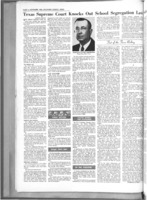 Southern School News-November 1955
 Texas Supreme Court in R.E McKinney et al v. W.C. Blankenship et al declared Texas Statutes that legalized the segregated school system were unconstitutional. In response, Governor Shivers and Attorney General Shepperd made public statements that this decision does not call for any speed-up of desegregation, stating, "In the light of these decisions, no school district should feel compelled to take hasty or unnecessary action." They also said there would be no plan to appeal the court's decision.
-
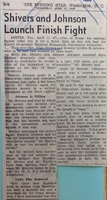 Washington Star 1956-04-11
 Allan Shivers and Senator Lyndon B. Johnson debate in the National Democratic Convention Delegation. Texas Democrats have been divided since Shivers led the G.O.P. campaign for Dwight D. Eisenhower in 1952. Johnson attempts to unite the Democratic Party of Texas, but says that he won't let himself be used as a rallying point for Southern conservatives fighting the Supreme Court desegregation opinion.
This demonstrates the split among the Democrats in Texas after the 1952 presidential election, and the Supreme Court desegregation decision.
-
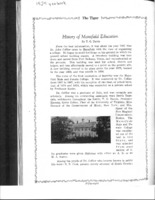 "History of Mansfield Education" from 1929 yearbook
 The pages from the year book discuss the history of Mansfield and the beginning of the school system prior to 1956.
-
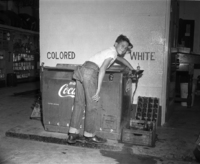 Mansfield segregated water fountain
 This photo - taken the month of the Mansfield desegregation crisis in 1956 - depicts a microcosm of Jim Crow-era segregation. In addition to separate water fountains, blacks and whites were separated in bus seating, theater seating, restaurants, health care, housing and in other everyday activities across the South.
-
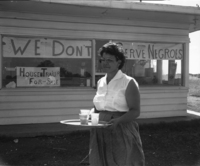 "We Don't Serve Negroes"
 Jim Crow laws marginalized African Americans by denying them access to private businesses and public facilities, creating "separate but equal" conditions. For example, many black Americans were forced to eat in the back of some establishments or not allowed in at all.
-
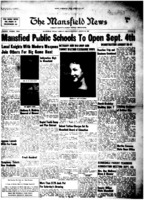 The Mansfield News coverage from August 30, 1956 of the beginning of Mansfield High School desegregation resistance
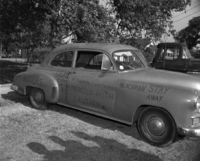
 The front page of The Mansfield News, dated August 30, 1956, recorded the indignation expressed by the predominantly white community to the mandatory court order on school integration. The article referenced an effigy "swaying realistically" from the school flagpole along with a “very artfully decorated” car at the scene.
-
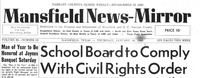 Mansfield News-Mirror front page coverage of school board decision to integrate
 On January 28, 1965, the Mansfield News-Mirror published a front-page story about the school board’s decision to integrate Mansfield schools. It also published a page 1 editorial encouraging the community to support the board’s decision and called for “sound thinking and responsible action” as well as a healing of “the wounds of the past.”
-
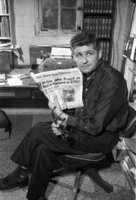 John Howard Griffin with Fort Worth Star-Telegram
 Mansfield author John Howard Griffin, who wrote the book "Black Like Me," holds a Fort Worth Star-Telegram newspaper, which includes a photo of an effigy someone hung of him. Griffin spent most of his life studying racial equality. In "Black Like Me" he changed the pigmentation of his skin and traveled through Louisiana, Mississippi, Alabama, and Georgia to explore the different levels of discrimination African Americans faced living in the deep south.
-
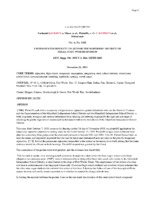 Justice Opinions of Jackson v. Rawdon 135 F. Supp. 936 and Jackson v. Rawdon 235 F. 2d 93
 Court opinions from the federal court case Jackson v. Rawdon and the following appeals court case show the differing opinions of judges on the issue of integration. Judge Estes originally ruled in favor of the Mansfield school board, saying they needed more time to develop a plan for school integration. The Fifth Circuit Court of Appeals disagreed and said the school board was violating the constitutional rights of the black Mansfield students. The case was tossed back and forth between federal and appeals court once more before Judge Estes ruled in favor of the students and ordered the school district desegregate immediately for the 1956-57 school year.
-
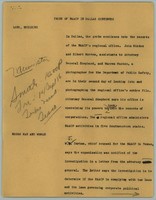 KXAS News Script-Probe of NAACP in Dallas Continues
 A news script and corresponding video from the KXAS news station on September 14, 1956, show lawyers from the state attorney general’s office searching through records at the Dallas NAACP offices. Attorney General John Ben Sheppard acquired a temporary injunction against the organization while he launched an investigation on the terms of tax fraud and barratry. A corresponding court case was brought to Judge Otis T. Dunangan the following month.
-
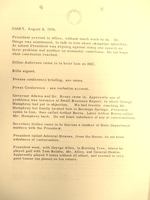 Dwight D. Eisenhower pre-press conference on Civil Rights 1956-08-08
 Ann Whitman, Dwight D. Eisenhower's secretary records notes on the press conference briefing that will be held in the next month. Eisenhower is urged to stay out of the civil rights platform plank discussion.
This demonstrates Eisenhower's "middle of the road" approach, and shows the tensions that resulted from the Supreme Court's decision (the Brown decision).
This also becomes a predecessor to what would happen at the "Mansfield Crisis", a month later.
-
 Students in front of Mansfield school bus
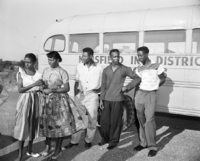
 Five African American students who planned to enroll in Mansfield High School stand in front of a Mansfield Independent School District bus. Students include Gracie Smith, Hattie Neal, Floyd Moody, John Hicks, and Charles Moody. The segregated school system in 1956 required African American students in Mansfield to attend I.M. Terrell High School in Fort Worth. Students would catch the Trailways bus from Mansfield to downtown Fort Worth and then walk about twenty blocks to the high school. The system made it difficult for students to participate in extracurricular activities and left students arriving home late in the evening. Inadequate bussing for students was one of many deficiencies found in the “separate but equal” clause for school districts. The Mansfield school board denied multiple improvement requests by the African American community, prompting the NAACP to petition the courts to force integration at the high school.
-
 Dwight D. Eisenhower's comments on the Supreme Court's decision, and desegregation 1956-08-19
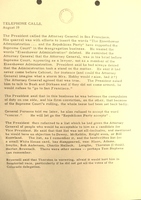
 Ann Whitman, Dwight D. Eisenhower's secretary describes a telephone conversation between Eisenhower and the Attorney General, Herbert Brownell, regarding the Supreme Court's decision (Brown v. Board of Education) and segregation.
According to Whitman, Eisenhower explicitly tells Brownell to not say "the Eisenhower Administration" have supported the Supreme Court in the desegregation business, before Brownell's brief before the Supreme Court. Eisenhower wanted Brownell to appear as a lawyer, not apart of the Eisenhower Administration.
This demonstrates Eisenhower's "middle of the road" approach to civil rights issues, and this becomes a predecessor to how Eisenhower would deal with the "Mansfield Crisis" a few weeks later.
-
 Crowd with alligator
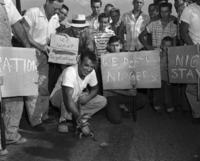
 During the protest against desegregation at Mansfield High School, John Pyles held a baby alligator as a warning to any African American who appeared on the school grounds that they would be "gator bait."
-
 Car painted with racial slurs
 A car painted with racial slurs is parked near Mansfield High School on August 30, 1956. Several hundred white citizens protested the registration of black students at the school. The protest was in response to the decision in the lawsuit of Nathaniel Jackson, a minor, et al. v O.C. Rawdon, et al. of the United States Fifth Circuit Court of Appeals in New Orleans overturning a lower court’s decision. The Fifth Circuit’s decision mandated that the Mansfield Independent School District allow African American students to register at the previous white-only Mansfield High School. No African American students registered that day.