-
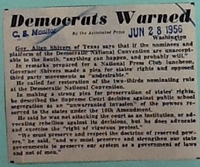 Christian Science Monitor 1956-06-28
 Allan Shivers makes his stance on states rights, by opposing the Supreme Court decision against public school segregation. This demonstrates Shivers views on the Brown decision, school segregation, and states rights.
-
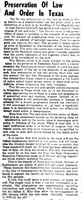 The Houston Informer 1956-09-15
 This editorial was the only mention of Mansfield for this day. Written nearly two weeks after the Crisis, it decried Governor Shivers’ actions in Mansfield. By sending in the Texas Rangers and ordering school officials to transfer out any students whose presence would be disruptive, this article claims he not only subverted the court order to desegregate immediately, he gave way to mob rule. They contrasted his decisions with those taken by the governor in Tennessee in regards to the events at Clinton.
-
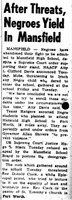 The Houston Informer 1956-09-08 pt. 3
 This article, found toward the back of the paper, finally discussed the events at Mansfield. It gave a cursory overview of the actions by the mob, the courts, and Governor Shivers. It also incorrectly stated that the Texas Rangers escorted Negro students to Fort Worth to attend school.
-
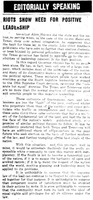 The Houston Informer 1956-09-08 pt. 2
 This editorial was placed two pages ahead of the article about the Mansfield Crisis. It was a commentary on what Mansfield meant to the law of the land. According to the article, the actions taken by the white mob, Governor Shivers, and the Texas Rangers, were in direct conflict with the lawful order to desegregate. It continued in a commentary about what this meant for the state and society in general.
-
 The Houston Informer 1956-09-08
 This article was on the front page of the paper after the Mansfield Crisis. It was focused on the events in Fort Worth with Lloyd G. Austin and the protestors at his home.
-
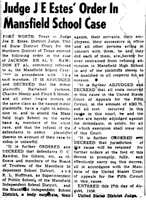 The Houston Informer 1956-09-01
 This article was simply a copy of the order from Judge Estes’ ruling on Jackson v. Rawdon. This was the lone article from the Houston Informer during the Mansfield Crisis.
-
 The Corpus Christi Times 1956-09-05
 This article gives the perspective of President Eisenhower to the issue of integration. The reporters, using Mansfield and Governor Shivers’ response to it, tried to get a straight answer out of the President, but only received the tale that he was not familiar enough with the actions to comment. It does note, however, that he believes each states’ response to their individual integration issues was effective in preventing violence. He refused to endorse the Supreme Court’s decision in Brown v. Board of Education, however.
-
 The Corpus Christi Times 1956-09-04
 This article details events at the school, including the arrival and departure of Rev. Clark, along with the harsh words from the mob. This came at the same time that the Rangers were told to transfer out of the district any students whose presence would be disruptive to the school, white or black. The rest of the article relates the story of Lloyd G. Austin in Fort Worth and the racial tensions in Alvarado in comparison to the problems at Mansfield.
-
 The Corpus Christi Times 1956-08-30
 This article provides a detailed account of events at Mansfield, including quotes from the mob. It very much focuses on the threats made by these men, as well as the non-committal responses from the school’s principal and the superintendent. The phone threat to T.M. Moody is discussed in better detail than in the Amarillo article. This article also focuses on the court process that the school board is currently going through. It includes the exact ruling made by Judge Joe Estes in the appeal to delay segregation.
-
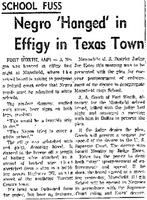 The Corpus Christi Times 1956-08-29
 This article focuses on the effigy found hanging on Main Street in Mansfield. Pulled off of the Associated Press wire, gives great detail to what the effigy looked like, and spells out the court appeals that the Mansfield School Board is currently pursuing.
-
 Washington Star 1956-03-28
 Rivalries are developing among the Democratic leaders in Texas. Allan Shivers "bolted" the Democrats to support Dwight D. Eisenhower in the 1952 presidential election. Samuel Rayburn names Senator Lyndon B. Johnson as "Texas' Favorite Son", due to his loyalty to the Democratic Party. This demonstrates the political tensions in Texas among the Democratic Party, after Shivers support for Eisenhower in the 1952 presidential election.
-
 Baltimore Sun 1955-09-26
 Allan Shivers sent Dwight D. Eisenhower a telegram, "we are remembering you in our prayers". This demonstrates the close relationship Shivers and Eisenhower had during their time in political office, and how Shivers helped carry Texas for Eisenhower in the last presidential election, in 1952.
-
 Washington Star 1956-09-20
 Allan Shivers claims that he will support Dwight D. Eisenhower in the upcoming presidential election of 1956. Shivers and his pro-Republican associates potentially face a much tougher job in this year's election. The governor is retiring from office, and since the 1952 presidential election he has lost control of the Democrats in Texas. Now the liberal Democrats Lyndon B. Johnson and Samuel Rayburn have a better chance at controlling the Democratic Party in Texas. This demonstrates the political tensions between the Democratic Party in Texas, and Shivers adamant support for Eisenhower. However, Senator Price Daniel succeeded Shivers, and carried out similar policies in Texas, including segregation in public schools.
-
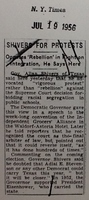 New York Times 1956-07-19
 Allan Shivers says that he advocates "vigorous protests" rather than "rebellion" against the Supreme Court decision for integrating public schools. The governor believes that Adlai Stevenson will not carry Texas in the 1956 presidential election. This demonstrates Shivers' views on the Brown decision and racial integration, one month before the "Mansfield Crisis" occurred.
-
 Washington Star 1956-09-19
 Allan Shivers announces that he will support Dwight D. Eisenhower for re-election for president, in 1956. Shivers states that he still opposes Adlai Stevenson for the Democratic nominee, since Stevenson has not changed his ideas of a "strong centralized government". However, the future governor of Texas, Price Daniel announces that he will support Stevenson in the 1956 presidential election since Stevenson opposed force in school integration cases.
-
 Chicago Tribune 1956-09-20
 Allan Shivers announces that he will support Dwight D. Eisenhower for re-election for president, in 1956. Shivers states that he still opposes Adlai Stevenson for the Democratic nominee, since Stevenson has not changed his ideas of a "strong centralized government". However, the future governor of Texas, Price Daniel announces that he will support Stevenson in the 1956 presidential election since Stevenson opposed force in school integration cases.
-
 Des Monies Registrar 1955-12-21
 Allan Shivers states that will never change his opposition on Adlai Stevenson, and that other Democrats "have sought to impose their own ideas of the party" above its traditional beliefs. Shivers supported Eisenhower during the 1952 presidential election. This demonstrates the tensions in the Democratic Party, after Shivers supported a Republican candidate in the 1952 election. It's apparent that Shivers will continue to support Eisenhower in the next election if Stevenson becomes the opposing presidential candidate.
-
 El Paso Herald Post 1956-09-05
 This article is also very similar to a Brownsville article run on the same day, September 5. This article, focusing on Clinton, TN, brings in Mansfield and Fort Worth for comparison, with an endnote on the racial tension in Sturgis, Kentucky. It is the first time the El Paso Herald Post drew correlations to racial tension outside of Mansfield.
-
 El Paso Herald Post 1956-09-04
 This article is about a quarter of the United Press story published by the Brownsville Herald on September 4. It focuses entirely on the Rev. Donald Clark and his treatment by the mob at the school. This is one of the only articles published by the El Paso Herald Post that included direct quotes from the mob, highlighting the sentiments felt by those present.
-
 El Paso Herald Post 1956-09-03
 This article, pulled off of the United Press wire service, is also very similar to another article run by the Brownsville Herald on September 3. This article, however, is much shorter, giving fewer details about Mansfield and more details about the Lloyd G. Austin incident. This gives the indication that Mansfield does not rate very high on their news feed.
-
 El Paso Herald Post 1956-09-01
 This article is also almost identical to an article in the Brownsville Herald, this time from September 3. The United Press seems to be where El Paso gets most of their news from in regards to Mansfield, meaning they run similar stories to Brownsville with few differences. This article relates the story from Mansfield about Grady Hight and the three photographers after Shivers sent in the Texas Rangers.
-
 El Paso Herald Post 1956-08-31
 This article is the first indication that the Mansfield Crisis was something worth really writing about…and it is almost an exact copy of the article published by the Brownsville Herald on the same day. The differences in the articles lie in the last few paragraphs, with the update of Shivers calling in the Rangers being placed just ahead of the duplicate article.
-
 El Paso Herald Post 1956-08-30
 This small article is the only indication that the racial tension at Mansfield was known by anyone in El Paso on the first day of the Crisis.
-
 Brownsville Herald 1956-09-07
 This article, one of the last to be run in the state in regards to Mansfield, shows Shivers hitting back at his critics (those critics mostly being the NAACP). He legitimizes his actions by comparing Mansfield and Clinton and their current state of racial tensions. He follows that up by concluding that “agitators” should be jailed for causing the racial tensions in the first place. This portends the fight that the Governor will bring against the NAACP.
-
 Brownsville Herald 1956-09-06
 This article portrays the dislike that the Texas Attorney General Ben Shepperd has for the NAACP. As Thurgood Marshall criticizes Texas’ Governor, the disdain that Shepperd holds for “outside interests” is extremely apparent, as is Marshall’s contempt for Governor Shivers’ orders in Mansfield.