-
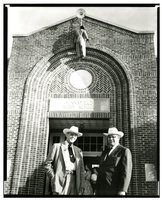 Texas Rangers pose in front of effigy at Mansfield High School
 On August 31, 1956 segregationists gathered at the Mansfield High School to prevent African American students from registering for the upcoming school year. The same day Governor Allan Shivers dispatched Texas Rangers to Mansfield as a sign to maintain law and order. The memorandum instructed Colonel Garrison to “arrest anyone, white or colored, whose actions are such as to represent a threat to the peace" (see footnote below). The first day of school and final day of registration was Tuesday, September 4. Captain Crowder dispatched a total of nine Texas Rangers on site that Tuesday morning as a precautionary measure for crowd control (see footnote below). No African American students registered or attended Mansfield High School in 1956.
Bibliography: Robyn Duff Ladino, Desegregating Texas Schools: Eisenhower, Shivers, and the Crisis at Mansfield High (Austin: University of Texas Press, 1996), 102, 111
-
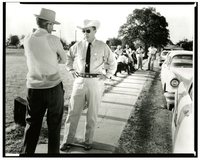 Texas Ranger in Mansfield
 Governor Allan Shivers ordered Texas Rangers to be dispatched in an effort to maintain order at the school as segregationists gathered to protest the federal court order to integrate students in 1956. The National Association for the Advancement of Colored People (NAACP) viewed the use of the Texas Rangers as an attempt to maintain segregation. Leaders of the NAACP saw the governor’s actions as contrary to the Supreme Court order. Governor Shivers blamed the problem at Mansfield on the NAACP and commented that “the paid agitators ought to be put in jail” (see footnote). The back and forth exchanges between both sides indicated the divisive nature of the integration issue as Mansfield became a battleground that challenged the “separate but equal” law when the NAACP filed Jackson v. Rawdon on October 7, 1955.
Bibliography: Robyn Duff Ladino, Desegregating Texas Schools: Eisenhower, Shivers, and the Crisis at Mansfield High (Austin: University of Texas Press, 1996), 117-118.
-
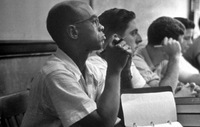 Heman Sweatt attends class
 Heman Sweatt became the first African American student to attend the University of Texas in 1950. His case, Sweatt v. Painter, brought early legal success to the NAACP in Texas after the Supreme Court declared the "separate but equal" doctrine UT tried to enforce did not give black law students the same educational opportunities as whites. However, this success was short-lived. Years later, the NAACP would battle the courts again over the desegregation of primary and secondary schools.
-
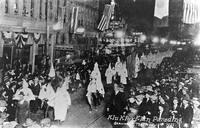 Ku Klux Klan march in Texas
 A parade of Klansmen march through the streets of Beaumont, Texas, in 1922. Because of increased Klan activity around the state, many chapters of the NAACP closed their doors in fear of retribution or harm.
-
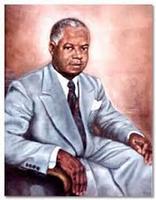 Portrait of A. Maceo Smith
 As a leader in the NAACP, Dallas native A. Maceo Smith helped to form the Texas State Conference of Branches in 1937. This alliance between Texas chapters helped the organization revitalize in the during and after World War II.
-
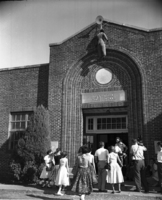 Mansfield students enter high school under the shadow of an effigy.
 An effigy hangs above the entrance to Mansfield High School as students file in the building on August 30, 1956. The effigy was hung as a protest to integration efforts in Mansfield. The effigy remained for several days.
-
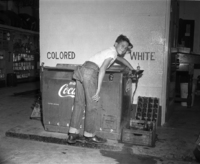 Mansfield segregated water fountain
 This photo - taken the month of the Mansfield desegregation crisis in 1956 - depicts a microcosm of Jim Crow-era segregation. In addition to separate water fountains, blacks and whites were separated in bus seating, theater seating, restaurants, health care, housing and in other everyday activities across the South.
-
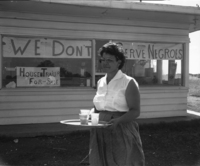 "We Don't Serve Negroes"
 Jim Crow laws marginalized African Americans by denying them access to private businesses and public facilities, creating "separate but equal" conditions. For example, many black Americans were forced to eat in the back of some establishments or not allowed in at all.
-
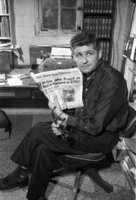 John Howard Griffin with Fort Worth Star-Telegram
 Mansfield author John Howard Griffin, who wrote the book "Black Like Me," holds a Fort Worth Star-Telegram newspaper, which includes a photo of an effigy someone hung of him. Griffin spent most of his life studying racial equality. In "Black Like Me" he changed the pigmentation of his skin and traveled through Louisiana, Mississippi, Alabama, and Georgia to explore the different levels of discrimination African Americans faced living in the deep south.
-
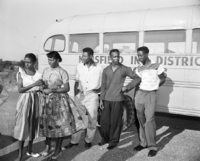 Students in front of Mansfield school bus
 Five African American students who planned to enroll in Mansfield High School stand in front of a Mansfield Independent School District bus. Students include Gracie Smith, Hattie Neal, Floyd Moody, John Hicks, and Charles Moody. The segregated school system in 1956 required African American students in Mansfield to attend I.M. Terrell High School in Fort Worth. Students would catch the Trailways bus from Mansfield to downtown Fort Worth and then walk about twenty blocks to the high school. The system made it difficult for students to participate in extracurricular activities and left students arriving home late in the evening. Inadequate bussing for students was one of many deficiencies found in the “separate but equal” clause for school districts. The Mansfield school board denied multiple improvement requests by the African American community, prompting the NAACP to petition the courts to force integration at the high school.
-
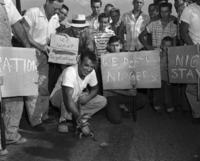 Crowd with alligator
 During the protest against desegregation at Mansfield High School, John Pyles held a baby alligator as a warning to any African American who appeared on the school grounds that they would be "gator bait."
-
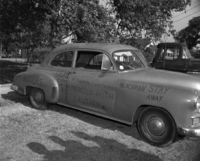 Car painted with racial slurs
 A car painted with racial slurs is parked near Mansfield High School on August 30, 1956. Several hundred white citizens protested the registration of black students at the school. The protest was in response to the decision in the lawsuit of Nathaniel Jackson, a minor, et al. v O.C. Rawdon, et al. of the United States Fifth Circuit Court of Appeals in New Orleans overturning a lower court’s decision. The Fifth Circuit’s decision mandated that the Mansfield Independent School District allow African American students to register at the previous white-only Mansfield High School. No African American students registered that day.
-
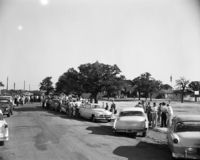 Congestion of cars at Mansfield High School
 A crowd assembled at the Mansfield High School grounds on August 31, 1956 to protest the registration of three African American students. The crowd included angry residents instructed to comply with a federal district court order. Heated exchanges occurred during the day between the radical segregationists and news reporters on scene to cover the events. The Fort Worth Star-Telegram reported that Tarrant County Assistant District Attorney Grady Hight exchanged words with the crowd and had to be escorted to safety by officers. The pro-segregationist gubernatorial candidate W. Lee O’Daniel also made a campaign appearance that day on the school grounds.
-
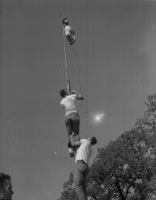 Attempt to remove the effigy on the flagpole
 An effigy prominently displayed from a flagpole on school grounds is hoisted in the early morning hours on Thursday, August 30, 1956. The citizens of the Mansfield community gathered on school grounds to protest court-ordered integration. Later in the morning, two men - J.T. Pressley and Willard Pressley, 20-year-old cousins - attempted to remove the effigy but were unsuccessful. School administrators refused to remove the effigy, and the gathering of segregationists returned the next day to school grounds to prevent the enrollment of African American students.
-
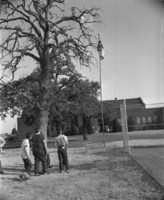 Effigy hangs on flagpole at Mansfield High School
 Thursday August 30, 1956 was the first day of registration for all students at Mansfield High School. A federal district court ordered the high school to integrate African American students a few days earlier. The school board and community of Mansfield disagreed with the mandated decree and tension mounted as demonstrated by the effigies hung on school grounds as a sign of protest. No African American students registered during the enrollment period and continued attending I.M. Terrell High School in Fort Worth. The high school did not fully integrate until 1965.
-
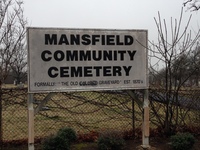 Mansfield Community Cemetery
 There was a time that even the cemetery in Mansfield, Texas was divided by race. The fence and sign dividing the “Whites Only” cemetery from “The Old Negro Graveyard” still remains. At some point “Negro” was erased and replaced with “Colored,” a sign of changing times. This, one of the last physical signs of Jim Crow in Mansfield, still stands in the Mansfield Cemetery.
-
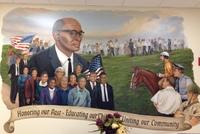 Bethlehem Baptist Church Mural
 When the addition of the T. M. Moody building was completed in 2006 at the Bethlehem Baptist Church, in west Mansfield, the church commissioned a mural in the entrance depicting the events of the Mansfield Crisis. T.M. Moody, the focal point of this mural, was a local citizen of Mansfield working with L. Clifford Davis, an attorney for the National Association for the Advancement of Colored People (NAACP), to enforce the integration of African American students at Mansfield High School after the 1955 Supreme Court decree of Brown v. Board of Education II. In the foreground of the mural on the left are recognizable residents of the African American community and some prominent members of the congregation of Bethlehem Baptist Church; in the right corner of the mural are the Texas Rangers and local law enforcement; in the background are the white residents of Mansfield. This mural stands as a memory to the congregation of the Bethlehem Baptist Church.
It should be noted that the artist employed artistic license in depicting the events of August 1956. Aside from the recognizable historical figures, the scenes borrow from other iconic images of other civil rights protests.
-
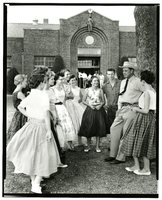 Mansfield High School: Texas Ranger, students, and effigy
 In this photograph, Mansfield residents surround one of two Texas Rangers in front of Mansfield High School in late August 1956. The Texas Rangers were in Mansfield by request of Governor Allan Shivers to stop any threat of violence when approximately 200 to 500 white residents of Mansfield and surrounding areas gathered at the high school to keep African American students from registering. As is visible in the background of the picture, a black painted effigy hangs over the entrance of the school.