-
 Civil Rights Act of 1960
 The Civil Rights Act of 1960 gave free education to children of members of armed forces, however it did not address the segregated school system prevalent across the country. The Civil Rights Act of 1960 also produced penalties for any person trying to keep another from voting or registering to vote. Unfortunately, the Civil Rights Act of 1960 still did little in the way of giving African Americans and Mexican American voting privileges and allowed schools to remain segregated across the nation.
-
 Brenda Norwood discusses sitting at the back of the bus and receiving secondhand books.
 Brenda Norwood discusses sitting at the back of the bus and receiving secondhand books.
-
Brenda Norwood discusses discrimination against African Americans.
Brenda Norwood discusses discrimination against African Americans, including lack of access to water, riding in the back of the bus and using secondhand books.
-
Brenda Norwood discusses more about the first day of integration.
Brenda Norwood discusses more about the first day of integration, including the crowd that gathered that day. Some members of the crowd taunted the African American students and called out derogatory names, Norwood said in an oral history interview.
-
 Floyd Moody talks about news media coming to IM Terrell.
 After early negotiations at Mansfield High School, Floyd Moody went on to IM Terrell, when news media started showing up at IM Terrell, he remembers classmates saying, "black folk trying to go to a white folk school, they are going to kill you."
-
Floyd Moody talks about a picture taken in front of a Mansfield bus.
Floyd Moody talks about a picture with students in front of a Mansfield bus. Moody also talks about there being only one black high school in all of Tarrant County.
-
Brenda Norwood discusses what a newly integrated Mansfield High School was like.
Brenda Norwood, an African American senior when Mansfield High School integrated, discusses what life was like at the school during an oral history interview.
-
Brenda Norwood discusses the first day of school when Mansfield integrated.
Brenda Norwood, member of the Mansfield High School senior class of 1965-66, discusses the first day of integration at Mansfield High School.
-
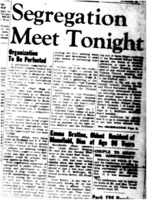 The Mansfield News "Segregation Meet Tonight"
 An organization known as the Webb Community Club was established by the Mansfield Citizens Council. This organization was established to keep segreation, and organize the people in the community that wanted segregation as well. Thomas B. West was placed as the temporary Chairmen of the organization. He urged everyone that wanted segregation to attend the meeting. Approximately 125 people both men and women of Mansfield attended. Albert North the club president spoke about the possible integration in light of the recent Supreme Court decision. Both African Americans and white citizens knew the integration of the schools would not resolve the racial issues.
-
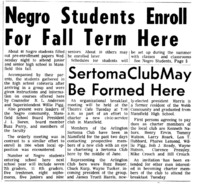 The Mansfield News-Mirror "Negro Students Enroll for Fall Term Here"
 Threatened with the loss of federal funding the Mansfield school board announced the district would integrate in the Fall of 1965. Approxmently 40 African American students enrolled for Fall classes as juniors and seniors. Mansfield School District also integrated still was for the most part segregated. The district claimed full enrollment of K-12 would overwhelm the district especially the elementary school. Therefore, the district offered two solutions: 1) build a new school but cannot afford it until 1966 so that would postpone full integration for another year. Or 2) reduce zoning districts and allow white students in the area of the colored elementary school to attend therefore integrating the colored school. Both were rejected by the federal government leaving the district to fully integrate.
-
Floyd Moody reflects on his feelings about the integration attempt of Mansfield High School.
Floyd Moody says he was not bitter or angry about integration events in 1956, he said about the white citizens of Mansfield, "they were raised up not having black folk in their school, maybe it wasn't that much against the race of black people, it was just something that was new to the individual and they couldn't accept it."
-
Floyd Moody discusses L. Clifford Davis backing off from the integration attempts at Mansfield High School and how the passage of time changes situations by itself.
Floyd Moody with regard to the integration attempt of Mansfield High School, "they didn't take us back, but the idea was there."
-
Floyd Moody remembers sitting around table at Mansfield High School with Superintendent R.L. Huffman and others discussing integration plans.
Floyd Moody remembers hearing the words he wanted to hear from Superintendent R. L. Huffman with regard to integration of Mansfield High School.
-
Floyd Moody discusses his father losing his home and his job as a sharecropper as a result of 1956 integration attempts at Mansfield High School.
Floyd Moody remembers the owner of the land his father was a sharecropper on encouraging his father not to enroll his son at Mansfield High School.
-
Floyd Moody discusses President Eisenhower's lack of involvement with 1956 integration attempts at Mansfield High School.
Floyd Moody says, "What really bothered me is the fact that our President, Eisenhower didn't do anything about anything."
-
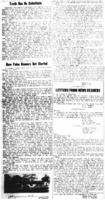 The Mansfield News Editorial "Truth Has No Substitute"
 On September 6, 1956 an article came out titled "The Truth Has No Substitute." The article says that the students were not the instigators they were being used as a tool for promotion. The African American children would be the ones humiliated. The article gives an overview of why Mansfield is the test case of Civil Rights and the integration movement.
-
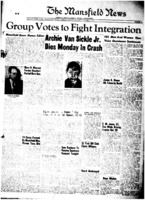 The Mansfield News "125 Men and Women Here Voice Unanimous Sentiments"
 On October 27, 1955 an article titled "125 Men And Women Here Voice Unanimous Sentiments" came out. 125 citizens of Mansfield School District voted unanimously at the Memorial Hall to oppose integration. The people of Mansfield gathered to oppose integration and gave their own opinions of why they should not integrate. There are opinions in the article from both sides, those who opposed and from those who were for integration.
-
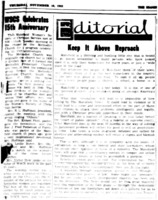 The Mansfield News Editorial "Keep It Above Reproach"
 On November 10,1955 an Editorial called "Keep It Above Reproach" came out giving an overview of what was going on in Mansfield. This editorial reflected the tension and overall problems in not just Mansfield, but also in society at the time. This article foreshadows what is to come in Mansfield and how it should be handled.
-
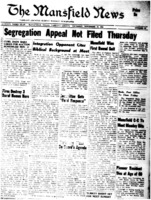 The Mansfield News "Segregation Appeal Not Filed Thursday"
 On November 10, 1955 an article in the Mansfield News came out titled "Segregation Appeal Not Filed Thursday." In the article the court order came from Joe E. Estes, denying three African Americans in to Mansfield High school. Around fifty men, women, and high school students from Mansfield gathered to hear the suit filed on the grounds that African Americans had to travel unfair distances to get to school.
-
Kenneth Pressley discusses his memories of the scene at Mansfield High School in 1956, including an effigy that was hanging.
Kenneth Pressley discusses his memories of the scene at Mansfield High School in 1956, including the hanging effigy. "It was a different world back then," Pressley said.
-
Kenneth Pressley discusses the events he witnessed at Mansfield High School in 1956.
Kenneth Pressley discusses the events he witnessed at Mansfield High School in 1956 during the attempt to integrate the school. He says now it seems like "it's just a part of history."
-
Kenneth Pressley discusses when integration in Mansfield schools took place in 1965.
Kenneth Pressley discusses when integration in Mansfield schools took place in 1965.
-
Kenneth Pressley discusses why he thinks some Mansfield residents were upset about the integration efforts of 1956.
Kenneth Pressley discusses why he thinks some Mansfield residents were upset about the integration efforts of 1956 during an oral history interview.
-
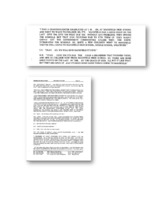 Mansfield African American Oral History Project, excerpt on when Mansfield finally integrated
 Maggie Jackson Briscoe shares her thoughts on the eventual integration of Mansfield schools.
-
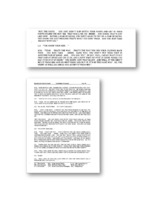 Mansfield African American Oral History Project, excerpt on difficulty from Jim Crow laws
 In Mansfield, everyday life for African Americans was made difficult by Jim Crow laws. Tasks as simple as buying a new pair of shoes were not easy for African Americans. They went into the store knowing their size because they were not allowed to try them on beforehand.