-
 Mansfield African American Oral History Project excerpt on integration efforts
 The excerpt discusses part of what led to integration efforts in Mansfield. Deacons of the Bethlehem Baptist Church thought if they were paying taxes in the town and had to pay for their children to ride the buses to Fort Worth to school, there must be a way that they could attend a school near their homes.
-
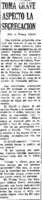 La Prensa, September 1, 1956
 An article from the Spanish newspaper dated September 1, 1956 described reactions across the country of the Supreme Court decision to desegregate public schools. The article described the gathering at Mansfield High School and verbal exchanges that took place between the protesters and the sheriff around escorting students to the school. No registration escorts occurred that day and African American students returned to I. M. Terrell High School for the 1956 school year. The article also mentioned the three arrests that occurred during integration at Clinton, Tennessee the same year.
-
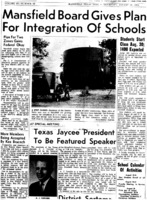 "Mansfield Board Gives Plan for Integration of Schools," Mansfield News-Mirror, August 19, 1965
 In 1965 the Mansfield school board, in compliance with the Civil Rights Act of 1964, approved a plan to allow all students in the junior and senior high schools to attend regardless of “race, color, or national origin.” It was the first year of integration in the small community and uneventful compared to reactions in 1956 when a federal court ordered the school district to desegregate. In 1965 the school provided bus transportation on an “equal basis” for all students, which differed from previous years when African American students rode a Trailways bus to Fort Worth and then walked to the I.M. Terrell High School.
-
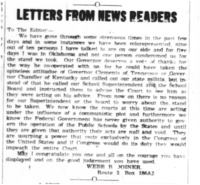 Mansfield News 1956 letter from reader
 The letter from a reader is an opinion consistent with the time period when many Texans thought the Supreme Court in ruling on integration overstepped its bounds with regard to states’ rights. In 1956 more Texans opposed integration than at the time of the unanimous court ruling on Brown v. Board of Education in 1954 (see footnote below). The letter writer also referenced the ‘influence of a communist plot.” Many within the state held a view that the communists influenced both the Supreme Court and National Association for the Advancement of Colored People (NAACP). In late 1955 the chairman of the Associated Citizens’ Council of Texas asked Texas Attorney General John Ben Shepperd to investigate the “communist influences” of the NAACP (see footnote below).
Bibliography: Robyn Duff Ladino, Desegregating Texas Schools: Eisenhower, Shivers, and the Crisis at Mansfield High (Austin: University of Texas Press, 1996), 40, 46, 41
-
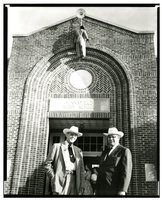 Texas Rangers pose in front of effigy at Mansfield High School
 On August 31, 1956 segregationists gathered at the Mansfield High School to prevent African American students from registering for the upcoming school year. The same day Governor Allan Shivers dispatched Texas Rangers to Mansfield as a sign to maintain law and order. The memorandum instructed Colonel Garrison to “arrest anyone, white or colored, whose actions are such as to represent a threat to the peace" (see footnote below). The first day of school and final day of registration was Tuesday, September 4. Captain Crowder dispatched a total of nine Texas Rangers on site that Tuesday morning as a precautionary measure for crowd control (see footnote below). No African American students registered or attended Mansfield High School in 1956.
Bibliography: Robyn Duff Ladino, Desegregating Texas Schools: Eisenhower, Shivers, and the Crisis at Mansfield High (Austin: University of Texas Press, 1996), 102, 111
-
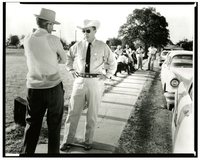 Texas Ranger in Mansfield
 Governor Allan Shivers ordered Texas Rangers to be dispatched in an effort to maintain order at the school as segregationists gathered to protest the federal court order to integrate students in 1956. The National Association for the Advancement of Colored People (NAACP) viewed the use of the Texas Rangers as an attempt to maintain segregation. Leaders of the NAACP saw the governor’s actions as contrary to the Supreme Court order. Governor Shivers blamed the problem at Mansfield on the NAACP and commented that “the paid agitators ought to be put in jail” (see footnote). The back and forth exchanges between both sides indicated the divisive nature of the integration issue as Mansfield became a battleground that challenged the “separate but equal” law when the NAACP filed Jackson v. Rawdon on October 7, 1955.
Bibliography: Robyn Duff Ladino, Desegregating Texas Schools: Eisenhower, Shivers, and the Crisis at Mansfield High (Austin: University of Texas Press, 1996), 117-118.
-
 Mansfield African American Oral History Project excerpt on African Americans dealing with discrimination at funeral homes during Jim Crow era.
 This excerpt was taken from the Mansfield African American Oral History Project. The quote shares the differences between African American funeral homes compared to the Anglo funeral homes. This difference was part of Jim Crow in Texas, and African Americans were not allowed to use the same funeral homes as the white Mansfield citizens. They later had to use African American funeral homes in Fort Worth, much like how children had to attend schools in Fort Worth instead of integrating schools in Mansfield.
-
 New York Times coverage of integration crisis in Mansfield
 An article published in the New York Times dated September 1, 1956 outlines details of the integration crisis that occurred in Mansfield Texas. Reactions to desegregation efforts varied throughout America and even within the state. Some school districts in Texas complied with the mandatory court order, while events such as the scene that transpired in Mansfield reflected a rallying cry to maintain segregation. Governor Shivers sent Texas Rangers to the scene with instructions to “arrest anyone, white or colored” in an effort to maintain peace. Although verbal assaults occurred, no individuals were arrested and the segregationists kept African American students from registering for school that year.
-
 Texas Observer coverage of Mansfield desegregation crisis
 The article detailed events that occurred on the school grounds in Mansfield, Texas in 1956. Opposition gathered to protest a federal court order that mandated immediate school integration. Outlined in the article were several verbalized responses and actions by the angry crowd, reactions by district officials, and Governor Shivers’ view of the situation. Nine years would pass before the school district officially integrated in 1965.
-
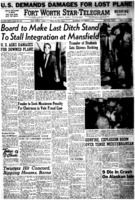 Fort Worth Star-Telegram September 1, 1956 coverage of MISD desegregation events
 The front page of the Star-Telegram, dated September 1, 1956, chronicled the attempts by the Mansfield Independent School District to seek a delay on the court ordered integration. Pictured to the left page of the article was J. A. Gooch, the attorney for the school district. Also captured were images of Assistant District Attorney Grady Hight and the mob scene as hundreds gathered at the school the day prior to protest the federally mandated decree. Governor Shivers also sent Texas Rangers to aid local officers and maintain control during the school enrollment period.
-
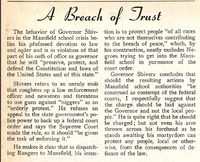 "A Breach of Trust" Texas Observer editorial, September 5, 1956
 An editorial protested Governor Allan Shivers’ response and handling of the Mansfield, Texas school integration crisis. Community citizens and outsiders gathered on August 30-31, 1956 in an effort to prevent African American students from registering at the high school. Governor Shivers sent the Texas Rangers to the scene to maintain order, although some believed it was directive to ensure segregation remained intact within the state.
-
 Montgomery County, Maryland
 Desegregation of Poolesville High School
-
 Jossie Brooks on Voting
 Jossie Brooks discusses when she was first able to vote in an election.
-
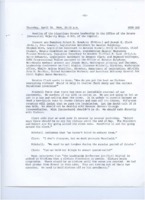 Bipartisan Meeting of Senate Leadership
 Minutes from a bipartisan meeting about the passage of the Civil Rights Act of 1964.
-
 Civil Rights Act of 1960
 The Civil Rights Act of 1960 expanded the power of the Commission on Civil Rights and addressed the issue of education for military families.
-
 Civil Rights Act of 1957
 The act established a bipartisan commission to investigate situations in which citizens were being deprived of their right to vote. The act allowed states to continue literacy tests and other requirements to vote. It did not address the desegregation of public education.
-
 Civil Rights Act of 1964
 The Civil Rights Act of 1964 called for reforms to bring about equality in American. Regarding public schools, the Act threatened to withhold federal funding from any school districts that did not integrate.
-
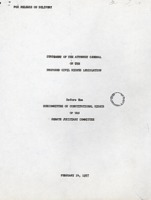 Statement by Attorney General on Proposed Civil Rights Legislation
 Brownell outlines the items that he wants in the act.
-
 Letter by Attorney General Brownell in 1956.
 Letter from Brownell to Vice President Nixon calling an expansion of civil rights.
-
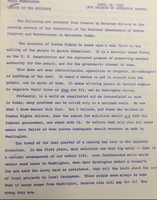 Press Memorandum Allan Shivers 1956-04-12
 Shivers philosophy on states’ rights stressed the need to assert the power of the people in contrast to the growth of the federal government. The federal government had been acting against the wishes of many Texans which pressured Shivers to reaffirm his strong stance on states’ rights.
-
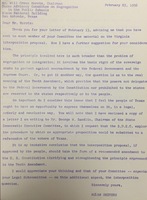 Allan Shivers to The Advisory Committee on Segregation 1956-02-23
 Shivers reaffirming his support for the interposition proposal and an amendment to the U.S Constitution clarifying and strengthening the Tenth Amendment.
-
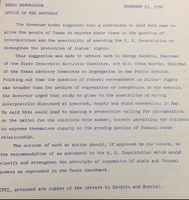 Press Memorandum Allan Shivers 1956-02-23
 Shivers proposed a referendum to Texas voters on the question of interposition by means of a constitutional amendment.
-
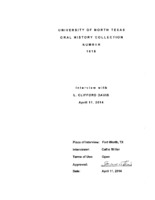 L. Clifford Davis Oral History Interview
 Transcript of an oral history interview with attorney L. Clifford Davis of Fort Worth, Texas
-
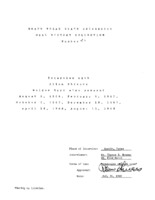 Allan Shivers Oral History Interview (2 of 2)
 Transcript of Shivers's oral history interview
-
 Eisenhower's Speech on Sending Troops to Little Rock
 President Eisenhower's speech describing the situation in Little Rock.