-
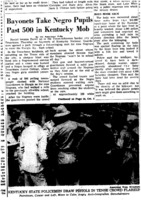 Atlanta Constitution: "Bayonets Take Negro Pupils Past 500 in Kentucky Mob"
 The Kentucky National Guard came to Sturgis to enforce the integration of the high school after a mob of segregationists prevented nine African American students from entering the school.
-
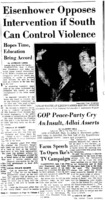 Atlanta Constitution: "Eisenhower Opposes Intervention if South Can Control Violence"
 In a press conference, President Eisenhower stated that he opposed federal intervention as long as local authorities maintained the peace.
-
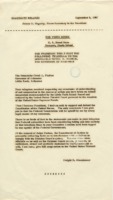 Eisenhower's Telegram to Governor Faubus
 President Eisenhower told Governor Faubus that he expects the governor to fully comply with the federal court order to integrate Little Rock's Central High School.
-
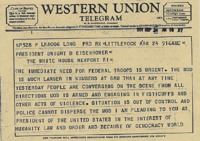 Little Rock Mayor's Telegram to Eisenhower
 Little Rock's mayor, Woodrow Wilson Mann, sent this telegram to President Eisenhower requesting federal troops to control the situation at Central High School.
-
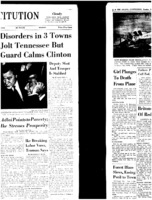 Atlanta Constitution "Disorder in Three Towns Jolt Tennessee"
 The Atlanta Constitution reported that violence occurred in Oliver Springs and Dayton, but Clinton remained calm due to the presence of the National Guard.
-
 Mansfield African-American Oral History Project
 The oral history project, conducted in December 1995, sheds light onto perspectives that African Americans shared about voting rights, Jim Crow laws, and life in Mansfield in the 1950s. The project was paid for partially through a Certified Local Government grant from the National Park Service, U.S. Department of the Interior, and administered by the Texas Historical Commission. Additional funding was given via matching grants from the Mansfield Historical Society and the Bethlehem Baptist Church congregation.
-
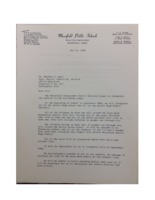 Integration plan dated May 12, 1965
 Ten years after the lawsuit to integrate Mansfield High School, in a letter sent to the Office of Health, Education, and Welfare, a plan is laid out for the integration of Mansfield School District. In this plan there is no mention of the high school being integrated, however, in August, three months after this letter is sent to Washington D.C., Mansfield High School is, in fact, finally integrated.
-
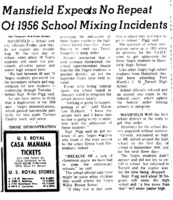 Fort Worth Star-Telegram article previewing Mansfield integration event in August 1965
 On August 21, 1965, the Fort Worth Star-Telegram published an article titled "Mansfield Expects No Repeat of 1956 School Mixing Incidents." This article describes the mentality of the population of Mansfield by stating that they don’t expect to face any resistance. Sixty to seventy African American students pre-enrolled into Mansfield’s junior and senior high schools to start attending in the fall of 1965.
-
 New York Times 1955-10-20
 Allan Shivers calls Adlai Stevenson, the Democratic nominee for the 1956 presidential election "coy". The Governor describes Stevenson as "the most extreme, in the most extreme group". This demonstrates that Shivers is not satisfied with the Democratic presidential nominee, and will continue to support Dwight D. Eisenhower in the next presidential campaign. This also demonstrates the division of the Democratic Party.
-
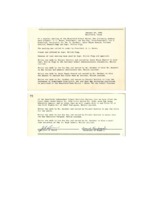 Mansfield ISD school board minutes, January 26, 1965
 Mansfield ISD school board minutes from a regular meeting held on January 26, 1965, show that a motion was made and seconded to sign the Assurance of Compliance Form H.E.W. 441, complying with the Civil Rights Act of 1964 and that the resolution would be published in the Mansfield News-Mirror see [Mansfield News Mirror, January 29, 1965, School Board to Comply With Civil Rights Order.]
-
 The Corpus Christi Times 1956-09-01
 This article gives a detailed account of the actions surrounding the Mansfield Crisis. Without going into much detail about the Grady Hight and photographer incidents, the article discusses, in depth, Governor Shivers’ call to the Texas Rangers and the reason behind it. It also details his curt response to L. Clifford Davis’ appeal for help for the students.
-
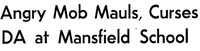 The Corpus Christi Times 1956-08-31
 This day had the most articles written about Mansfield. The first article is a story about the NAACP pushing the black students to enter into the court case. Focusing on Floyd Moody, the article alleges that he never wanted to go to Mansfield, that he preferred his “own people”, but that he would go to Mansfield if the NAACP made him. This article, which ran in several newspapers, created the backlash that saw Attorney General Ben Shepperd file suit against the NAACP.
The second article focuses solely on the Mansfield School Boards’ appeal in Houston, informing the reader that the board’s last appeal is to the U.S. Supreme Court.
The smallest article is the same updated headline that was in the El Paso Herald Post on the same day, August 31. Below this update, the same Irwin Frank article from the Fort Worth Star Telegram was printed.
-
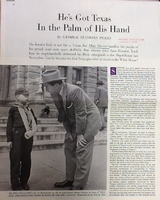 Saturday Evening Post 1953-06-27
 A reporter gives a description of Allan Shivers.
-
 Christian Science Monitor 1954-08-13
 Allan Shivers has "bolted" his party to work for the 1952 presidential election for Dwight D. Eisenhower. Shivers broke the "Solid South", which had consistently voted for Democratic presidential candidates since the end of Reconstruction. The Governor says public school segregation of races will not be discontinued as long as he his Governor. Samuel Yarborough, Shivers opponent in the 1954 Governor's race claims that Yarborough has had "secret communications with the National Association for Colored People (NAACP) during the campaign. This demonstrates the break down of the Democratic Party in Texas and the South, and Shivers stance on school segregation.
-
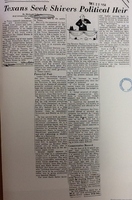 Christian Science Monitor 1954-12-21
 Due to Texas' population expansion and population growth, the state has become an important political post for presidential campaigns. During the 1952 presidential campaign, Governor Allan Shivers supported the Republican candidate, Dwight D. Eisenhower. This started a division between the conservative and liberal Democrats of Texas. This demonstrates the political divisions in the Democratic Party, in Texas.
-
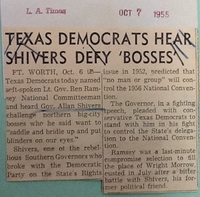 Los Angeles Times 1955-10-07
 Allan Shivers challenges northern "big city bosses" who he said want to "saddle up and put blinders on our eyes". Shivers pleas for conservatives to join him on the the fight for states' rights. This demonstrates Shivers strong stance on states' rights.
-
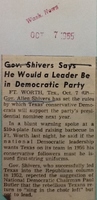 Washington News 1955-10-07
 Allan Shivers announces that if the national Democratic leadership wants Texas in the 1956 presidential campaign then the party nominee must be exceptional. This demonstrates that Shivers is not supportive of the current Democratic nominees for the next presidential election, but the issue leaves the Democratic Party divided.
-
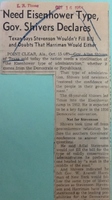 Los Angeles Times 1955-10-14
 Allan Shivers announces that the Eisenhower administration should continue whether it comes from a Democrat or a Republican. The Governor says he will plan on supporting Dwight D. Eisenhower in the 1956 presidential election. Shivers remains opposed to Adlai Stevenson, since Stevenson does not "fit the bill for a mildly conservative". This demonstrates that Shivers is dissatisfied with the Democratic candidates, and remains adamantly supportive of Eisenhower.
-
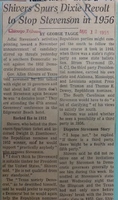 Chicago Tribune 1955-08-12
 Allan Shivers announces that he, and a few other governors decided that Adlai Stevenson is a "decisive loser" for the 1956 presidential election. Shivers says he would practically support anyone other than Stevenson. However the Deep South is in dispute since political party lines will or might be crossed. This demonstrates that the South is politically divided, despite it's solid history for support for the Democratic Party. Also, this gives hint to who Shivers will most likely support in the next presidential election.
-
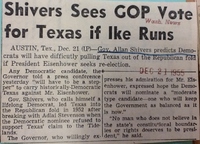 Washington News 1955-12-21
 Allan Shivers believes Democrats will have a hard time taking Texas in the 1956 presidential election. Shivers states that he will not support the Democratic nominee, Adlai Stevenson, since he refused to support Texas' claim to the tidelands. Shivers expresses his support for Dwight D. Eisenhower since Eisenhower is a "moderate type" of candidate, and who will keep the government balanced. This demonstrates Shivers adamant support for Eisenhower.
-
 Denver Post 1956-03-02
 Allan Shivers announces his retirement from public office. Shivers supported Dwight D. Eisenhower during the 1952 presidential election, since Eisenhower signed over the tidelands to Texas. The Governor states his stance on states' rights, but denies his stance had anything to do with schools or segregation. Instead, Shivers claims that states rights specifically protected "federal interference". This demonstrates that states' rights position was a way to oppose integration in public schools.
-
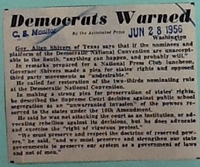 Christian Science Monitor 1956-06-28
 Allan Shivers makes his stance on states rights, by opposing the Supreme Court decision against public school segregation. This demonstrates Shivers views on the Brown decision, school segregation, and states rights.
-
 The Houston Informer 1956-09-15
 This editorial was the only mention of Mansfield for this day. Written nearly two weeks after the Crisis, it decried Governor Shivers’ actions in Mansfield. By sending in the Texas Rangers and ordering school officials to transfer out any students whose presence would be disruptive, this article claims he not only subverted the court order to desegregate immediately, he gave way to mob rule. They contrasted his decisions with those taken by the governor in Tennessee in regards to the events at Clinton.
-
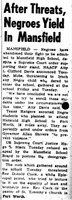 The Houston Informer 1956-09-08 pt. 3
 This article, found toward the back of the paper, finally discussed the events at Mansfield. It gave a cursory overview of the actions by the mob, the courts, and Governor Shivers. It also incorrectly stated that the Texas Rangers escorted Negro students to Fort Worth to attend school.
-
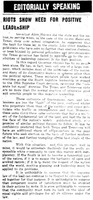 The Houston Informer 1956-09-08 pt. 2
 This editorial was placed two pages ahead of the article about the Mansfield Crisis. It was a commentary on what Mansfield meant to the law of the land. According to the article, the actions taken by the white mob, Governor Shivers, and the Texas Rangers, were in direct conflict with the lawful order to desegregate. It continued in a commentary about what this meant for the state and society in general.