-
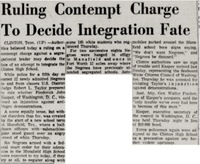 Brownsville Herald 1956-08-31 pt. 2
 In this article, Mansfield is discussed in addition to the racial problems in Clinton, TN. Although the topic of Mansfield is only three paragraphs long, it is filled with information about the events at Mansfield that were really only reported closer to the town itself. The mention of submachine guns and racial signs on cars near the school were hardly reported elsewhere. This article, from Clinton, TN, shows that the Mansfield Crisis was being reported in conjunction with violent racial confrontations that happened in other states.
-
 Brownsville Herald 1956-08-31
 This long-winded article focuses on the violence and threat of brutality that has taken place at Mansfield. It is one of the few articles that claims Assistant District Attorney Grady Hight was in an actual fight, as well as damages inflicted on faces. It also keeps up the effigy count for Mansfield and Fort Worth. This is also one of the only articles that discusses Governor Shivers, the NAACP, and U.S. Attorney General Herbert Brownell.
-
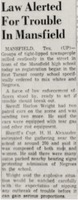 Brownsville Herald 1956-08-30
 These two article discuss the situation in Mansfield and Fort Worth. The first article gives scant details about the scene at Mansfield other than a police presence and a “group” estimated at 200 men and women. While the situation in Mansfield was considered possibly explosive by the County Sheriff Harlon Wright, he did not consider the effigy hung on Main Street to be a “serious matter”. Instead, District Judge David McGee did, especially in conjunction with another effigy hung up in similar fashion in Fort Worth. Both articles set the scene for racial tension in the area, as well as the response from those in charge.
-
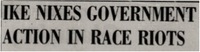 Amarillo Daily News 1956-09-06
 This article gives the reader the insight to the federal response to integration. As President Eisenhower pleads for moderation in the segregation “dispute”, he informs the nation that he will not intervene unless a state or local government cannot “maintain order”. Even after being informed of Governor Shivers open defiance of the integration order, he evades the question of action by stating he has no knowledge of what was said or done, but has asked for a full report on the court case involving Mansfield.
-
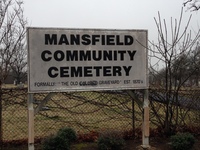 Mansfield Community Cemetery
 There was a time that even the cemetery in Mansfield, Texas was divided by race. The fence and sign dividing the “Whites Only” cemetery from “The Old Negro Graveyard” still remains. At some point “Negro” was erased and replaced with “Colored,” a sign of changing times. This, one of the last physical signs of Jim Crow in Mansfield, still stands in the Mansfield Cemetery.
-
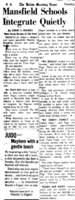 "Mansfield Schools Integrate Quietly"
 After a long history of segregation in Mansfield, as the title of this Dallas Morning News article reads, “Mansfield Schools Integrate Quietly.” In 1956 some residents of Mansfield were not ready to accept the Brown v. Board of Education II decree that school districts must integrate with “all deliberate speed.” When the Civil Rights Act of 1964 was announced and funding was going to be withheld, the school district complied. According to minutes from the Mansfield School Board meeting on January 26, 1965, the Assurance of Compliance form H.E.W. 441 would be signed and they requested an announcement to run in the Mansfield News-Mirror accepting compliance with the Title VI of the Civil Rights Act of 1964. This section of the Civil Rights Act prohibited discrimination on the basis of race, color, and national origin in programs and activities receiving federal financial assistance. According to the article, on August 31, 1965, the integration of African American students finally happened peacefully and quietly.
-
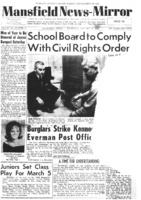 "School Board To Comply with Civil Rights Order" headline and "A Time for Understanding" editorial
 On January 28, 1965, the Mansfield News-Mirror published a front-page story about the school board’s decision to integrate Mansfield schools. It also published a page 1 editorial encouraging the community to support the board’s decision and called for “sound thinking and responsible action” as well as a healing of “the wounds of the past.”
-
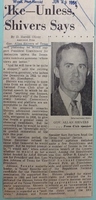 Washington Post Herald 1956-06-29
 Governor Allan Shivers announces his support for President Dwight D. Eisenhower during the 1956 presidential election. He makes it clear that he'll support a Republican candidate until "a better one comes along" Shivers discusses school segregation issues. This demonstrates that Shivers still strongly supports Eisenhower.
-
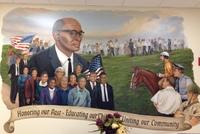 Bethlehem Baptist Church Mural
 When the addition of the T. M. Moody building was completed in 2006 at the Bethlehem Baptist Church, in west Mansfield, the church commissioned a mural in the entrance depicting the events of the Mansfield Crisis. T.M. Moody, the focal point of this mural, was a local citizen of Mansfield working with L. Clifford Davis, an attorney for the National Association for the Advancement of Colored People (NAACP), to enforce the integration of African American students at Mansfield High School after the 1955 Supreme Court decree of Brown v. Board of Education II. In the foreground of the mural on the left are recognizable residents of the African American community and some prominent members of the congregation of Bethlehem Baptist Church; in the right corner of the mural are the Texas Rangers and local law enforcement; in the background are the white residents of Mansfield. This mural stands as a memory to the congregation of the Bethlehem Baptist Church.
It should be noted that the artist employed artistic license in depicting the events of August 1956. Aside from the recognizable historical figures, the scenes borrow from other iconic images of other civil rights protests.
-
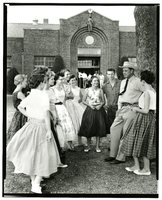 Mansfield High School: Texas Ranger, students, and effigy
 In this photograph, Mansfield residents surround one of two Texas Rangers in front of Mansfield High School in late August 1956. The Texas Rangers were in Mansfield by request of Governor Allan Shivers to stop any threat of violence when approximately 200 to 500 white residents of Mansfield and surrounding areas gathered at the high school to keep African American students from registering. As is visible in the background of the picture, a black painted effigy hangs over the entrance of the school.
-
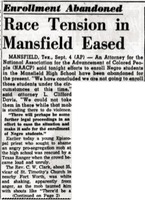 Amarillo Daily News 1956-09-05
 This article brings the Mansfield Crisis into focus with other segregation issues around the state as well as locally to Amarillo. While discussing racial problems in Alvarado, a town near Amarillo, the article also keeps the reader updated on the racial problems in Fort Worth, especially with Lloyd G. Austin and the violence surrounding his decision to stay in a previously all-white neighborhood. It also makes it apparent that the same priest, Rev. C. W. Clark, showed up in both Fort Worth and Mansfield to speak to the crowds assembled. The Mansfield mob, less inclined to hear him, caused him to be “rescued” by a Ranger. Also, as the school board lost its final appeal to the Supreme Court, a Mansfield business owner claimed to have a statement from the 12 black students that said they had no intention of attending Mansfield High School for the current year.
-
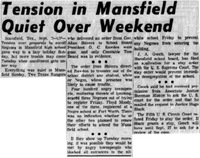 Amarillo Daily News 1956-09-03
 This article relates the still simmering tensions in Mansfield. While stating that nothing happened over the weekend, it leaves no doubt that the mob will return on Tuesday to continue to keep black students from enrolling. It also apprises the readers that Floyd Moody, one of the black students from the court case, had registered at a Negro School in Fort Worth. The rest of the article is meant to inform the reader of the current legal battle for the Mansfield School District and what channels of appeal are still available to them.
-
 Amarillo Daily News 1956-09-01
 This article, and the picture that accompanied it on the front page, builds the tension that had already started to boil the day before. It details the mobs’ efforts to search for blacks’ on incoming school buses, as well as a confrontation and shoving match that ensued between the mob and Assistant District Attorney Grady Hight of Fort Worth. Governor Shivers wastes no time in laying blame with the NAACP for the problems at Mansfield as he sends orders to both the Texas Rangers and the school. The NAACP, through attorney L. Clifford Davis, refuses to subject the black students to the threat of violence and unsuccessfully attempts to enroll them via telegram. The article also progresses the courtroom battle for the Mansfield School District saying the appeal in Houston was denied.
-
 Amarillo Daily News 1956-08-31
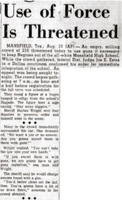
 This article focuses on the anger of white residents towards the mandate of integration. That anger is directed at black residents who would try to register, the County Sheriff who showed up at the school, and the Judges who are mandating integration. Machine guns in the hands of the mob was mentioned more than once, and threats of violence to one Mansfield black resident shows the lengths to which the white mob is willing to go. The article also states how many school districts are already integrated in the state, as well as the Mansfield School Board’s next step in their fight against integration.
-
 Amarillo Daily News 1956-08-30
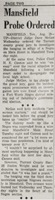
 This article relates the reaction from a Federal District judge to an effigy found hanging on Main Street in Mansfield. Equating the seriousness of the effigy to voter fraud, the judge also hints that more trouble may be coming to Mansfield in the next few days. The article also notes the reactions of the Tarrant County Sheriff and L. Clifford Davis, neither of whom takes the effigy to be a “threat of violence” against the blacks of Mansfield.
-
 Photo of Norvell Reed (1922)
 Norvell Reed, black resident of Denton, Texas was born in 1921, in Quakertown shortly before the residents were forced to relocate.
-
 Oral History Interview with Billie Mohair (2017; 5 of 5)
 Excerpt of an Oral History Interview, Billie Mohair, black resident of Denton, Texas recollects on her experiences with the women in the Fellowship. Additionally, Mohair discusses her family.
-
 Photo of Quakertown home (unknown date)
 Photograph of Quakertown home of Maude Woods [Hembry] Clark, who was a relative of Alma Clark's husband, William. This home was built in 1905 at 97 Terry Street. It was relocated in 1921 to make way for a city park. Horses and railroad ties were used to transport the house to 1129 East Hickory Street in the Solomon Hill neighborhood of Denton, Texas. Alma and William Clark eventually resided in this home.
-
Oral History Interview with Billie Mohair (2017; 4 of 5)
Excerpt of an Oral History Interview, Billie Mohair, black resident of Denton, Texas recollects on her experiences with the women in the fellowship. Additionally Mohair reflects on growing up during this time period.
-
 Photo of Quakertown residents (1910)
 Studio portrait of a young couple. John Amus Clark, on the left, wears a three-piece suit and felt hat. Maude Woods Clark [Hembry], on the right, wears a striped blouse, a plaid skirt, and a straw hat.
-
Oral Interview with Mae Nell Shephard Benford (2017;6 of 6)
Excerpt from interview with Mae Nell Shephard, a black resident of Denton. Mae Nell Shephard describes her childhood and moving to Denton.
-
 Photo of Quakertown doctor (1923)
 Portrait of Dr. E. D. Moton, the first African American doctor in Denton, visible from the chest up, wearing a dark-colored suit with pens in the jacket pocket
-
Oral History Interview with Ruby Cole and Alma Clark (2017: 7 of 7)
Ruby Cole discusses her views on the National Civil Rights movement of the 1960s.
-
Oral History Interview with Catherine Bell (2017; 8 of 11)
-
Oral History Interview with Ruby Cole and Alma Clark (2017: 5 of 7)
Alma Clark and Betty Kimble discuss the positive impact of the DWIF on Denton.